The Tao of Leela
A question opens a path
A contemplative game of life, consciousness and change.
Life brings moments of clarity and confusion, attachment and release, movement and stillness. How do we meet them? What do we notice, and what remains outside our awareness?
Tao of Leela offers a space to explore these questions through symbolic play. Here, consciousness means our awareness of experience: how we perceive a situation, respond to it, and come to see it differently.
The game brings together an Indian tradition of spiritual board games, the Chinese Book of Changes, and contemplation of the Dao, the Way. No prior knowledge of these traditions is needed. Begin with curiosity about life.
Leela: life as a journey
Leela belongs to the Indian spiritual-board tradition associated with Gyan Chaupar, the game of knowledge. Historical boards taught paths toward spiritual liberation: ladders aided progress; snakes marked hindrances. These varied games gave rise to the familiar Snakes and Ladders.
Here, the 72-state Leela board is a map of life and consciousness. Each position offers a perspective for reflection, not a measure of personal worth.
Background: Impart Encyclopedia of Art, Gyan Chaupar.
I Ching: the Book of Changes
The I Ching, or Yijing, is an ancient Chinese classic used for divination and philosophical reflection. Its 64 hexagrams are patterns of six solid or broken lines, representing Yang and Yin. Changing lines turn one pattern into another.
Traditionally, coins or counted yarrow stalks yield a pattern to consult about a question. This game uses a digital yarrow ceremony. Its images and words invite reflection on what is changing and how one might respond.
Background: Columbia University Press, The Classic of Changes.
Dao: the Way
Dao, also written Tao, means the Way. Daoist thought invites attention to ways of living in relation to the natural unfolding of things.
Here, contemplating the Way means noticing circumstances and considering a more aware response. This meeting of traditions is the game's creative interpretation.
Background: Stanford Encyclopedia of Philosophy, Daoism.
Whose journey will you imagine?
From this broad contemplation of life, the game invites you to explore a particular point of view. Perhaps an elderly scholar is learning to relinquish certainty. Perhaps a young traveller is wondering what belonging means.
You are the Player: the person who observes, imagines and chooses. You create and guide one or more Personas, constructed identities through which to contemplate the Way. A Persona enters the Leela Field, asks questions and encounters change. Its Journey preserves those experiences.
This separation creates room to explore. A Persona's age, circumstances and beliefs need not be your own. You can consider how life might appear from another position without making an autobiographical disclosure.
Each Persona has an independent history. You remain free to recognise personal parallels, reject a reading, or simply observe. What the experience means to you is yours to decide.
One encounter, at your own pace
- Create or resume a Persona. Give it a name and a situation to explore.
- Bring a question. Ask from that Persona's point of view.
- Follow the yarrow ceremony. Generate one complete line per click, six lines in all.
- Consider the pattern. Observe the hexagram and its changing lines.
- Reflect and continue. Record what stays with you and acknowledge movement.
For the scholar, you might ask:
What might become possible if certainty gave way to curiosity?
The journey at a glance
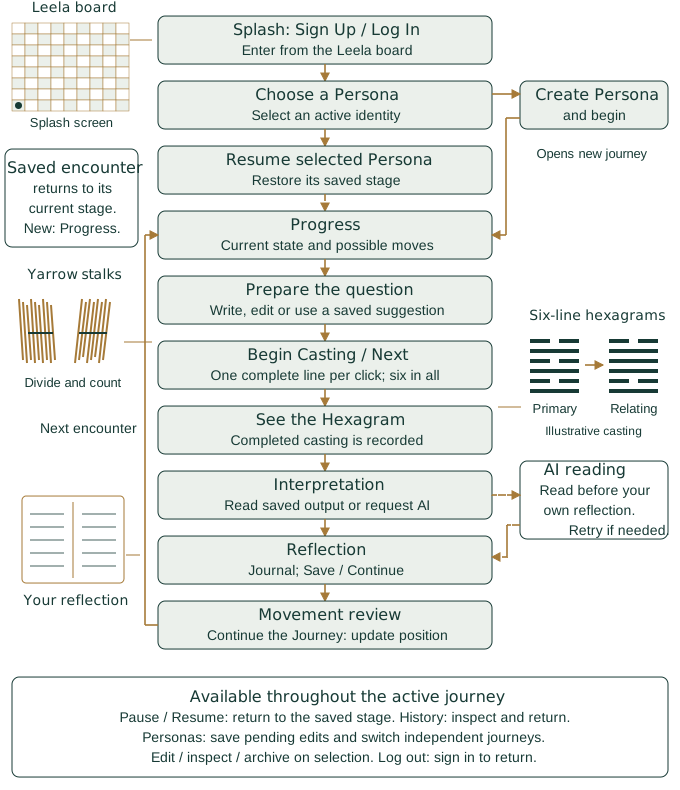
The diagram shows the live /journey/ interface, with schematic board, yarrow,
hexagram and journal illustrations. Resume restores the selected
Persona's saved stage; it does not restart an unfinished encounter. The guided flow requests an AI reading before personal reflection. The board position updates only when movement is acknowledged.
Pause, History and switching Personas preserve the accepted journey state.
AI proposes; the Player chooses
AI assistance offers possible readings grounded in the supplied reference material. You can use a suggested question, edit it or replace it before casting. Your own reflection follows the reading; you decide what to make of it.
The system is an interpretive companion, not an authority on the Way. It does not seek to diagnose its Player or equate a Persona's characteristics with the person guiding it.
Begin a journey
Open play.leela.day, sign up or log in, and choose Create Persona and begin. A name, a situation and a little curiosity are enough to begin.
For a browser-only introduction, open the preview journey. The labelled development preview uses example data and does not create an account or save a live journey.
About this edition. Tao of Leela is a working prototype. Reference texts cover all 64 hexagrams and all 72 tiles. Live castings use fresh random seeds and the balanced Leela probabilities rather than traditional yarrow frequencies. Snakes and ladders carry a Persona to their destinations after landing. Personas still journey independently; evolving visual histories and Persona encounters remain future work.
Read the User Manual for a first encounter, saving and resuming, and the current prototype limits. The Developer Manual (in the source repository) explains how the symbolic model becomes working software.